
Basic card games are great to keep in you treatment toolkit. They can be modified in so many ways, to address so many different areas of occupation and function. Here are five of my personal favorites.
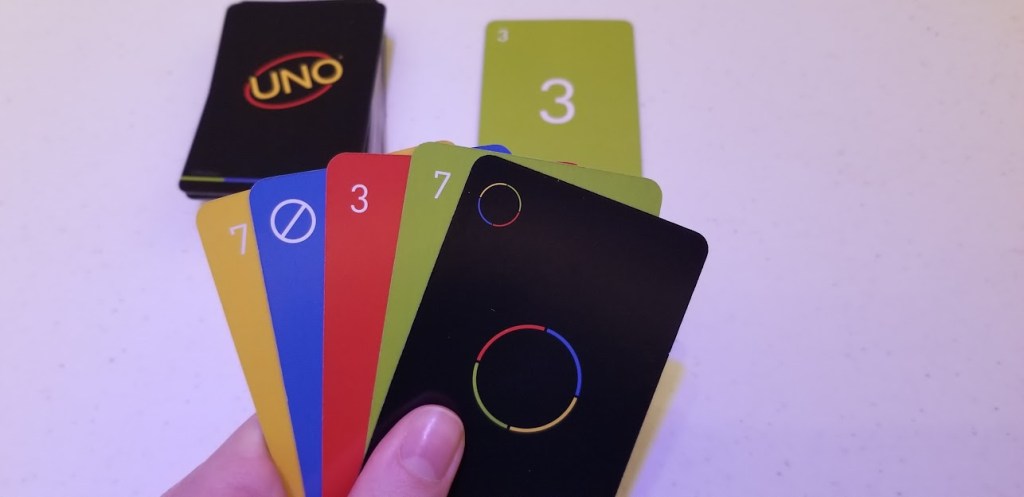
1. Minimalist UNO. We all love a good game of UNO, am I right? I’ve found that there are SO many ways to integrate this game into treatment sessions (and not just for cognitive interventions). I actually found this version of UNO totally on accident but it has been on of my BEST purchases for cognitive interventions. The traditional UNO cards totally work, but with this version there is just less distraction on the cards, which I think makes the colors more obvious. There’s less to consider when trying to visually process everything that’s on the card, making direction following a little bit easier. Did you catch Tuesday’s post with treatment ideas for this game?
2. Pokeno. So this game is essentially Bingo, but it uses standard playing cards instead of the traditional Bingo numbers. I like using this in treatment sessions as opposed to traditional Bingo because there is more to consider when trying to find a matching card on the game board. You could certainly make your own version of this game with 2 decks of cards, but the game boards in this set save time when setting up the game and have an overall sleeker look (in my opinion).
3. Blink. Out of all of the games I’ve included in this post, this one is my very favorite. It’s created and produced by the same group who created UNO, and is relatively the same as UNO but with a fun little twist. It’s a card matching game. When played by traditional rules, the deck is divided evenly among all players, with the exception of 3 cards that start 3 separate discard piles. Players are able to discard cards onto any of the 3 discard piles by matching the card at the top of their hand by color, number, or shape. There is no turn-taking, everyone plays at the same time, with the goal of discarding their hands as quickly as possible (hence the name ‘Blink’!). Again, there are SO many ways you could grade a vary this game to address essentially whatever you want within a treatment session.
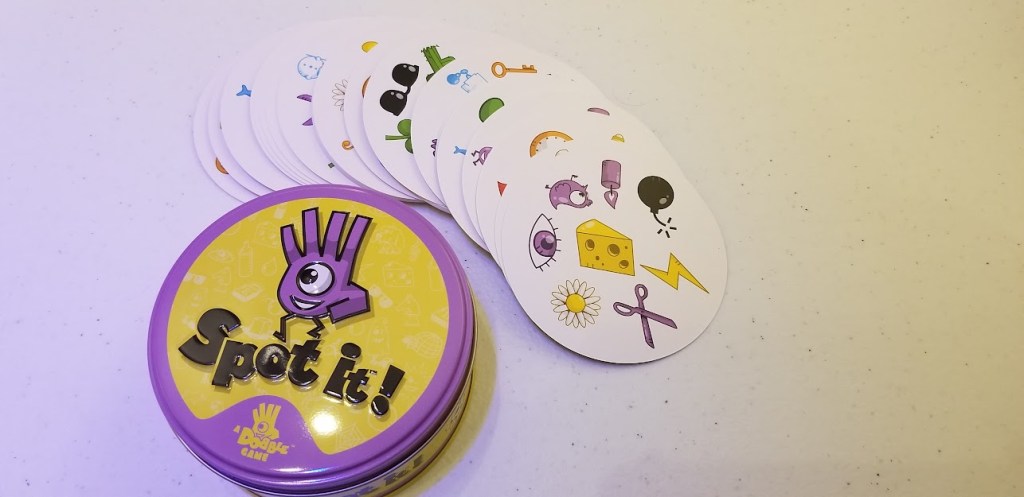
4. Spot It. The first time I saw this game was on my pediatric 12-week clinical while in OT school. Once I transitioned to LTC as a practicing therapist, I didn’t see it again until our speech therapist brought it in. The game consists of 55 round cards that each have 8 different symbols on one side. No matter how you play, there is ALWAYS 1 matching symbol between any 2 cards. When I play the game by following the provided directions, I find it’s typically a just-right challenge for individuals with mild to moderate stages of cognitive impairment. And I’ve yet to find someone who gets bored of it. There are of course tons of ways to modify this game to address various treatment needs within a session.
5. Tangrams. When I was growing up, just about every elementary school classroom had a set of these on the shelf. I’m pretty certain we had a set at home too. This game is great for addressing visual perception, direction following, and sequencing. It can also be a great tool for working with sustained attention to task to promote safe and meaningful engagement during functional routine.
I’d love to hear what games you love using in treatment sessions, I’m always working to build my toolkit! And stay tuned for some more in-depth treatment idea posts using these games.
(as an Amazon Associate I earn from qualifying purchases)





 The Memory Unit OT
Leave a comment