
It’s no secret that OTs address toileting skills *insert sarcastic smirk here*. But let’s be honest, sometimes we have to get creative when it comes to addressing all the necessary components in a way that results in long-lasing carryover (especially when working in a long-term care setting).
So let’s talk about that.
First and foremost, we as the therapist have to fully know and understand what aspects of the task need work. Yet another reason why a comprehensive evaluation is so essential. (If you need to start there, I’ve got a Free Eval Kit just for you!)
From there, we can talk about treatment strategies.
Simulated Resistive Clothing Management
This is a really fun one; and not my original idea but I just think it’s so darn creative! All you need is a piece of theraband tied into a loop (and maybe a grab bar or two). Tie the theraband loop so that if fits snug but not tight around your Patient’s hips. Then ask the Patient to don and doff the piece of theraband as they would a regular pair of pants, all the while focusing on the area of clothing management that is the most difficult.
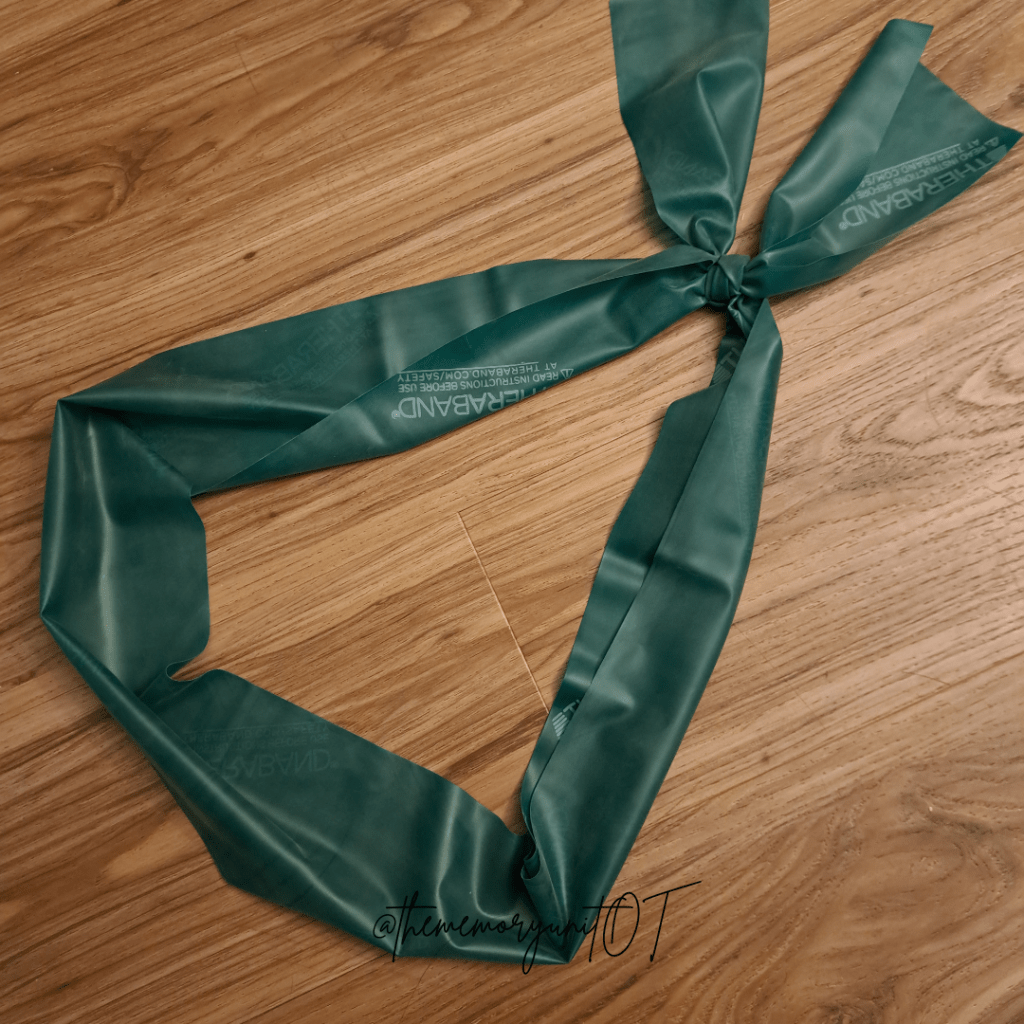
And it could be any or all areas. Reaching the feet to thread the legs through the pants. Pulling up the pants in the front. Getting the pants down (or up) in the back. Maintaining balance through it all! You can address literally all of these areas with this one simple technique.
Part of what makes this strategy so great is it’s versatility. You can use this technique anytime, in any treatment space. The Patient’s actual clothing remains on their body the entire time. You don’t have to wait for them to need the bathroom to trial these skills. And you can increase resistance and challenge by making the loop tighter.
The “Between-the-Legs” Ball Toss
This is my secret (not-so-secret) way to address balance and functional reach in the context of thorough perineal hygiene.
I take something small like a tennis ball or a hackey-sack. I hand it to the Patient and ask them to pass the ball from one hand to another between their legs and then toss it into a nearby bin or basin. We’ll switch it up throughout by passing from front to back, then back to front, and alternating which hand is front vs. back.
Ideally this would be performed in standing, but if an individual is unable to maintain prolonged standing at this particular point in their care continuum, we can absolutely work on this same weight-shifting skill in sitting (and sometimes sitting on a clean commode can improve success).

Repetitive Transfer Training
This may seem like an obvious one, but here’s what I really want you to remember. New learning can occur in individuals living with dementia when 100 repetitions of a novel task are performed.
If you’re working on transfer skills, it’s likely because there is some re-learning that needs to occur to ensure transfers are safe. So practice the transfer. Then practice it again. Then again. And again and again and again.
(Not necessarily all in one session, but make sure you’re engaging those repetitive actions – practicing safe and fluid skills each time.)
External Memory Devices
There will always be a cognitive component to safely and effectively using the bathroom. So we absolutely have to consider each Patient’s cognitive skills when addressing independence in the bathroom.
There are some instances where those 100 repetitions can be effective in improving cognitive carryover, particularly when sequencing through the steps of the task. But in instances were cues are still required, external memory devices are a great solution.
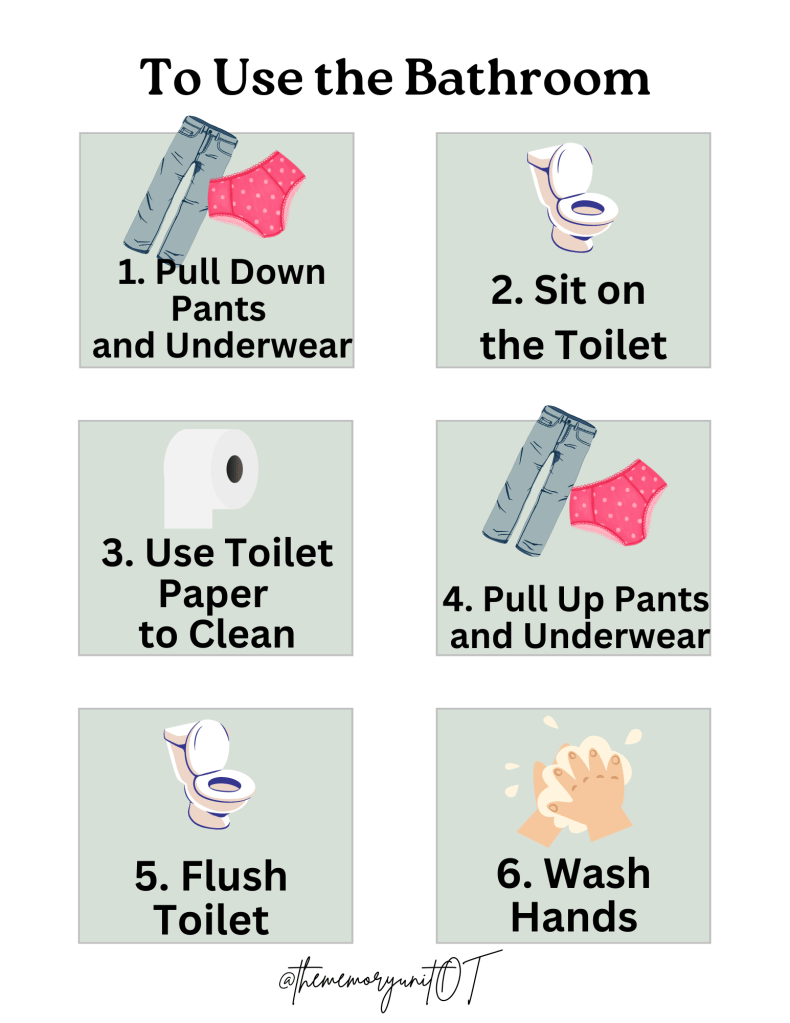
We don’t need anything elaborate here. Just a simple checklist with clear, large font. Including clipart-style images can be all the more effective in maximizing understanding. And carryover is strongest when we integrate these memory devices into sessions to ensure that our Patient understands how and when to reference them.




 The Memory Unit OT
Leave a comment