We’ve talked about why Sensory Integration matters in dementia care, so let’s talk a bit more specifically about how to assess it.
In my experience, older adults living with dementia who also have dysregulated sensory systems will either not show the natural reflexes that are typically intrinsically present in order to increase proprioceptive input independently OR they will attempt to get increased proprioceptive input in unsafe or inappropriate ways.
Typically they become more frustrated, will walk around for hours at a time without resting, and will be resistant to verbal redirection alone. And unfortunately, within the skilled nursing setting, will often be labeled as showing “increased behaviors”. They may also show an increase in frequency of falls, sometimes resulting in injury.
So in the clinical setting, when I’m asked to assess a Resident on The Memory Unit due to “increased behaviors” or increased instance of falls, I’m always going to perform a Sensory Assessment.
In general Occupational Therapy Practice, I’m a huge proponent of the Sensory Profile. I used it significantly during one of my Level II placements, and found it to be highly effective in identifying therapeutic strategies to improve sensory regulation. However, due to the nature and detail of the questions, it’s not the ideal assessment for dementia care. There’s a lot of introspection and short-term memory that’s required, which can be overwhelming for individual’s living with dementia.
Because of this, I’ve created my own modified version. It is entirely a screen and not at all a formal or standardized assessment. But I like having something that’s a little more structured than my own informal observation to give me some direction when treatment planning.
For the sake of space, this is just 3 of the entire 7-page tool.
You can download the entire document for free below.
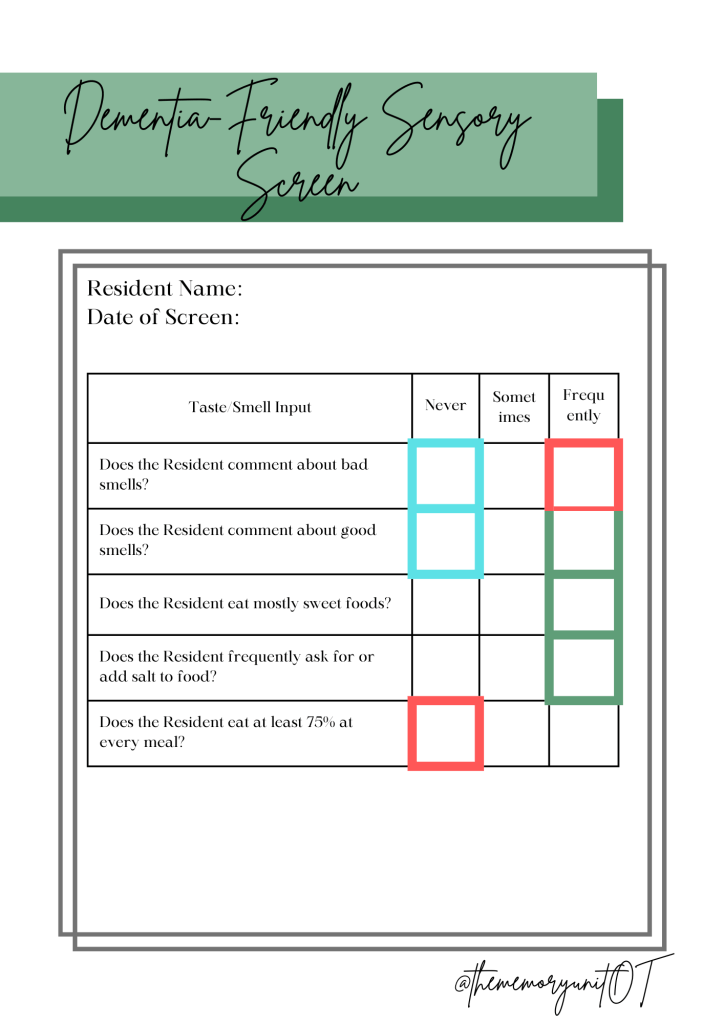
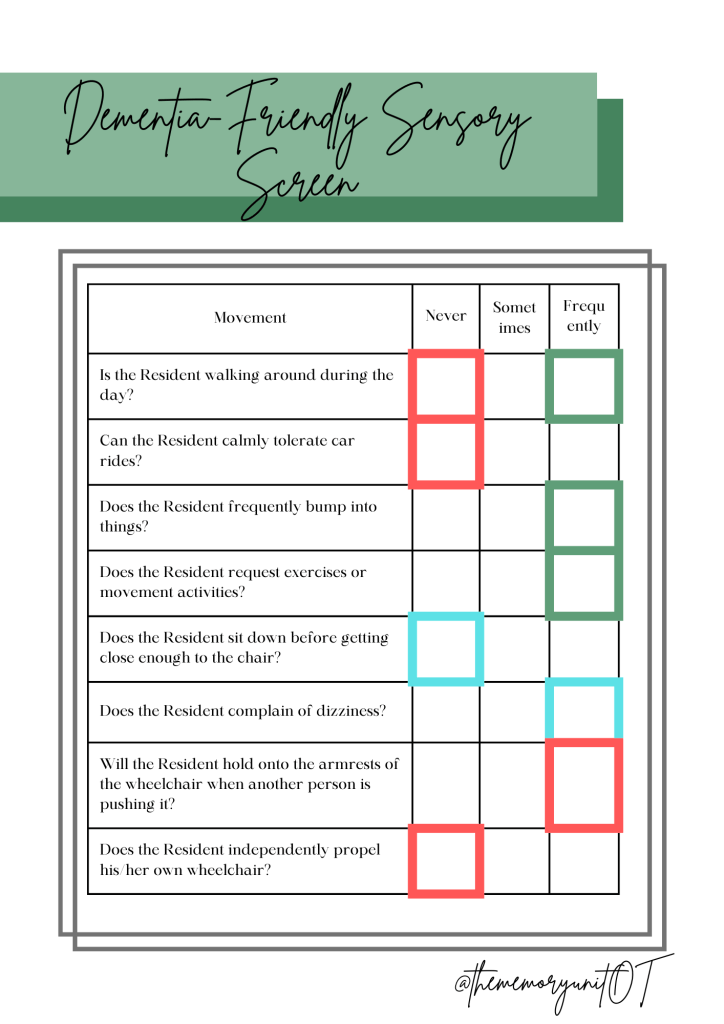

Now, let’s break the key down a little bit.
Sensory Sensitivity typically refers to a hypersensitivity that results in increased distress and dysregulation. Think of that weird texture you hate to touch or a smell that makes you gag or the way your brain goes numb when music is too loud.
Sensory Seeking typically refers to the need for increased sensory input because that input that is naturally received in day-to-day life isn’t enough. It’s the need to be hugged tight, under a heavy blanket, running fast, or chewing on crunchy food or a piece of gum to remain focused and calm.
Low Registration typically refers to a diminished sense of the sense. Individuals with low registration don’t notice and are not aware of sensory input enough to really react with and respond to the input. This one’s kind of tricky in relation to dementia care, because someone might be showing symptoms of low registration when really it’s more of a cognitive or executive function deficit caused by the disease process.
It’s important to know and remember that we’re never going to get anything definitive from this screen.
Rather, it’s going to give us some direction on what types of interventions to trial first. And that’s the real thing about sensory integration: a lot of it is trial and error.
So if a Resident scores high in sensory sensitivity, I’m going to focus on strategies that help them cope with instances of increased sensory input while also providing places where they can receive a sensory break. Whereas if a Resident scores high in sensory seeking, then I’m going to focus on strategies that will increase all sensory inputs until I find the ones that they enjoy and respond best to.
The proof is in the pudding here. You won’t know if these strategies are effective enough for full integration into a care plan until you trial them over the course of a full assessment period.
Give this a try, and let me know what you think! And as always, if you have any questions please reach out to me 🙂
Sources:




 The Memory Unit OT
Leave a comment