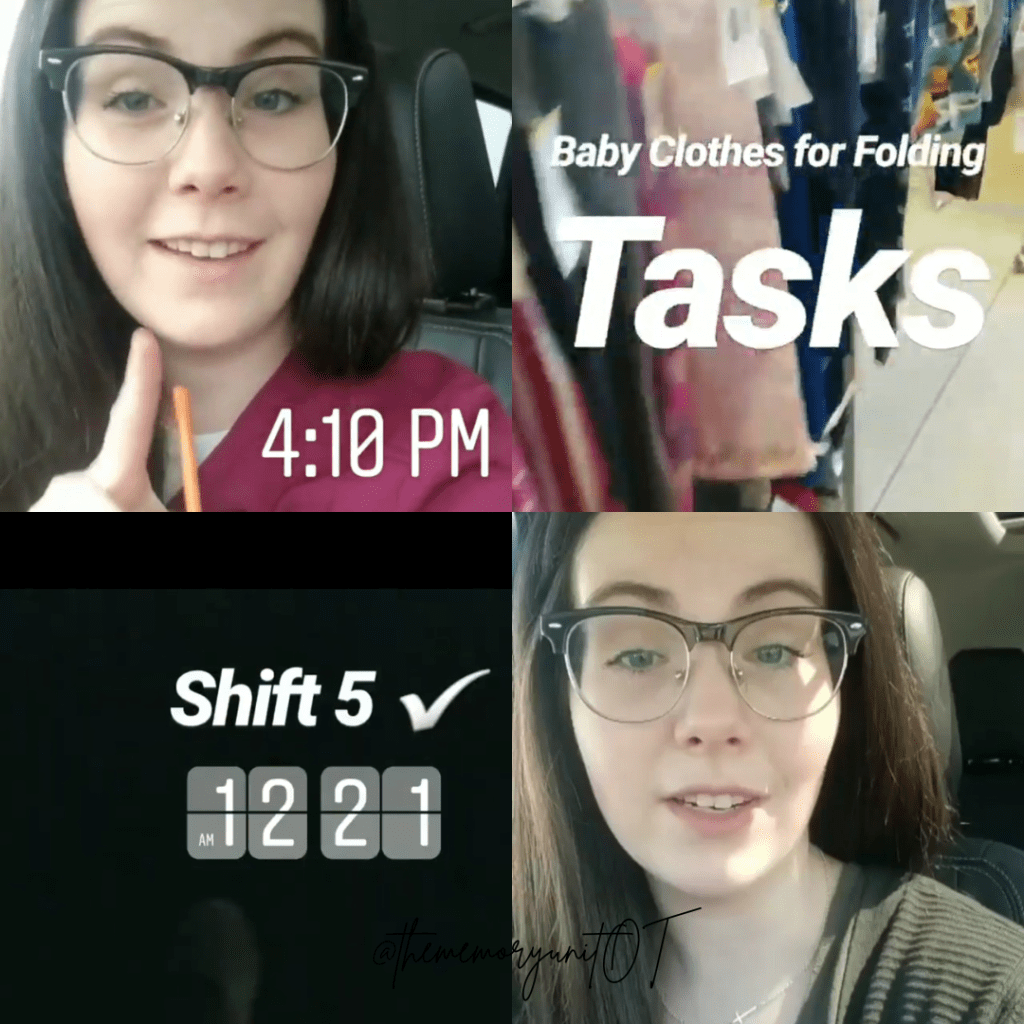
In 2019, I was part of a collaborative program development for better Sensory Integration on The Memory Unit of the facility I was working in. The team included myself, the COTA, and the SLP. We had a great system in place to improve sensory regulation and engagement during the day. But I noticed that things sort of deteriorated after shift change at 3pm. There were reports of some Residents constantly exit seeking through the night, a few increases in falls, and some Residents who were up all night and therefore could not wake up in the morning or engage in any of the daytime activities.
Because we were having really great success with these sensory techniques during the day, we wanted to make sure that we could provide education to all of the staff across all shifts. The hope being that everyone could get on the same page and we could ensure continuity of care.
After talking with the Rehab Director, I volunteered to be in the building for the late evening and early overnight for a one-week period. This would allow me to engage with all of the staff, get a better understanding of what the challenges were at night, and still therapeutically treat all of the long-term care Residents we had on program.
I would get to work around 5pm, starting my shift when the Residents were starting dinner.
I would help with tray pass and treat any Residents who we had on program for meal engagement and nutrition.
After dinner, the staff were desperately trying to get everyone to the bathroom and start the evening ADL routines.
Historically, there was always less nursing staff in the evening, and of course the Life Enrichment/Activities Department ended their days at 5pm. Which naturally meant less hands on deck.
So the Residents who weren’t being actively assisted really had nothing else to do or engage in. And unfortunately this resulted in a lot of unsafe ambulation and exit seeking. Residents were bored and were looking for something to do. This was evident to me right away, so Night 1 I started a gross motor group in the Living Room of the unit. Every Resident had to pass through this room when leaving the Dining Room, which gave me the perfect opportunity to invite each one to join in.
This was nothing extravagant. A balloon volley, a ring toss, something like that. But we did it every night and it was a great activity to keep the Residents engaged and safe while the staff assisted with self care.
I would make sure that at least one of my Patients was present, and would bill the session based on whatever that Resident was working on in therapy (be it balance, attention, or community engagement). If I had more than one Patient present, and each one had the same general goals, I would bill it as a group.
After that, I moved on to evening ADL routines.
Which meant that anyone I normally treated in the morning for ADL training, I treated in the evening instead. It worked out fairly well overall, and I was able to bill for these sessions just like I would any other ADL training session.
At this point, it was time to move on to the 1:1 sensory sessions.
These sessions were focused on Residents who tended to be awake all night or who just had a really hard time maintaining a good night’s sleep.
There were certain sensory interventions that just worked among our particular Resident population.
Deep pressure via joint compressions or massage while wearing a weighted blanket. Hand washing in warm soapy water followed by hand massage. Putting weighted cuffs around baby dolls and then rocking the doll to “sleep”. Pushing Residents around the facility in their wheelchairs for at least 20 minutes for increased vestibular input. Taking walks if able.
Curiously, I had to really mix up the types and orders of interventions that I provided. What worked great for a certain Resident during the day, had the opposite effect in that same Resident at night.
For these sessions, how I billed for it depended on the type of input provided. If I used joint compressions or massage, I would bill it under manual therapy with the focus of the treatment note being on the “increased proprioceptive input for improved emotional regulation and comfort”. If I used heavy work, wheelchair mobility, music, or ambulation, I would bill it under therapeutic activities (again placing the focus of the treatment note as “using xyz technique to improve proprioceptive and vestibular input for improved emotional regulation, comfort, and safety”).
In addition to providing 1:1 sessions, I collaborated a ton with the nursing staff.
I wanted to provide inservices on Sensory Integration and what it can do, but I also didn’t want to approach the situation as if I knew everything and I thought they knew nothing.
So instead of saying, “Hey! Here I am with all this great stuff I know” I said, “These are things I’ve been noticing during the day and I’d like to try some strategies at night but I’d also like to hear your thoughts and perspectives”. And truth be told, this not only helped me to productively accomplish what we were all there to do, but it also gave me a newfound and deeper rapport with the second-shift staff (that went a long way beyond this one week of treatment).
Longevity and feasible strategies that could carryover among the staff beyond this one week was a huge goal for me.
So I set aside time throughout the week to create a Sensory Strategy Kit. It was essentially a tote bin that was kept under the nurses’ station desk. I filled it with weighted baby dolls, stress balls, baby clothes for folding and touching, essential oil rollers, soft wash cloths, sensory bags and bottles, coloring pages with crayons, and a few weighted blankets. I also included an inventory list as well as a single-page instruction sheet to give guidance on when and how to use the kit.
Overall the week was a success!
I was able to build a deeper rapport with the Residents and staff, together we implemented strategies to improve overall care, and I gained a newfound perspective on dementia and how it can impact people in various circumstances and ways.
At the time, I documented my experience throughout the week on Instagram. Those clips have been compiled into one video that you can watch here!



 The Memory Unit OT
Leave a comment