
I was recently asked “How do I better communicate information to the interdisciplinary team?” This is a great question, and one I’m sure many people have.
Looking back on my own experiences with interdisciplinary team (IDT) meetings, my first few (okay, maybe more than a few) were rough. New grad me fumbling over my words and definitely NOT feeling confident about the information I was trying to communicate OR the ways in which I was trying to communicate said information.
Maybe I’m just hoping this is true for my own self, but I’m sure I’m not the only one who has ever felt this way.
So let’s break down the top 5 things you should focus on if you want to better communicate with the IDT.
1. The Current Therapy Goals.
It’s important that everyone on the team not only understands what goals you’ve set for this patient, but why you set those goals. Review the short and long term goals. Include the projected timeframe for the goal. Educate the team on how your evaluation and assessment led you to these goals.
2. The Most Recent Therapy Interventions.
Briefly summarize what you’ve been doing in treatment sessions. What time of day do you typically treat this patient? What sorts of occupations are you addressing? What sorts of activities are you including in treatments why? How has this patient been responding to these interventions? This is really your time to discuss what’s going well and what needs more improvement.
3. Updated Standardized Testing Scores.
Objective data tends to sell the most. Meaning, if you want to demonstrate quickly and efficiently what the deficits are and how therapy services are making improvements, use standardized testing. Be sure to include score at evaluation and any updated scores over the last assessment period to show progress. (Though it’s not standardized, this is a great time to talk about assist levels, ROM, strength, and balance grades too! Anything that will map out progressions is key).
4. Recommendations for Care Plan Changes.
If you’ve concluded information or found strategies that will improve quality of care and quality of life, you absolutely need to communicate this to the IDT. Don’t wait until discharge. Talk about strategies, adaptive equipment, visual cues. Anything that you’ve found to be consistently beneficial over the last assessment period should be communicated.
5. Recommendations for Continued Services.
If you believe that additional therapy services are needed, and the objective data and goal statuses can demonstrate this, advocate for it. Discuss what you recommend to address moving forward and why these services need to happen now.
Now, this may seem like a lot of information. You don’t have to be long-winded here. Concise, clear information without extra fluff will certainly get the job done and clearly communicate your role in improving this individuals care and quality of life.
In order to make things a little easier, I’ve created a single-page communication sheet where therapists can highlight the five points we’ve just discussed. This can be something you take your own notes on to bring to an IDT meeting, or something you write out formally and send to members of the IDT.
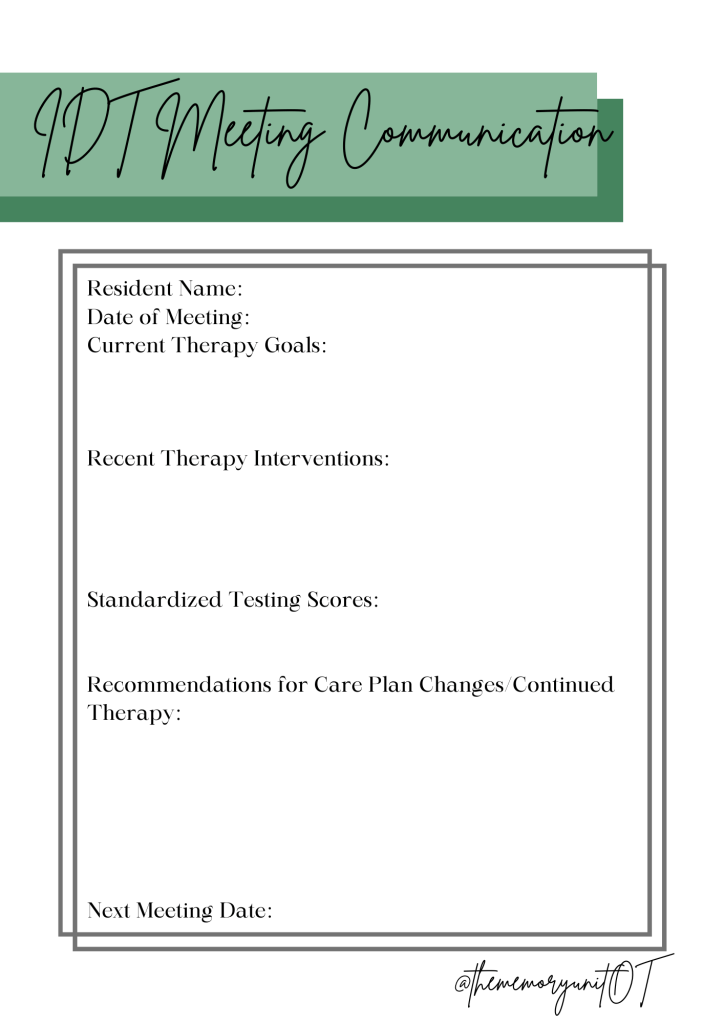
As always, this is meant to be a helpful resource that will hopefully make this part of the job a little easier for you, should this be something you struggle with.
I’d love to hear your personal strategies in mastering IDT meetings!





 The Memory Unit OT
Leave a reply to What Even is the IDT and Why Should I Care? – Allison Brush MS, OTR/L Cancel reply